Decorative plaster, tadelakt or clay for walls, how to choose
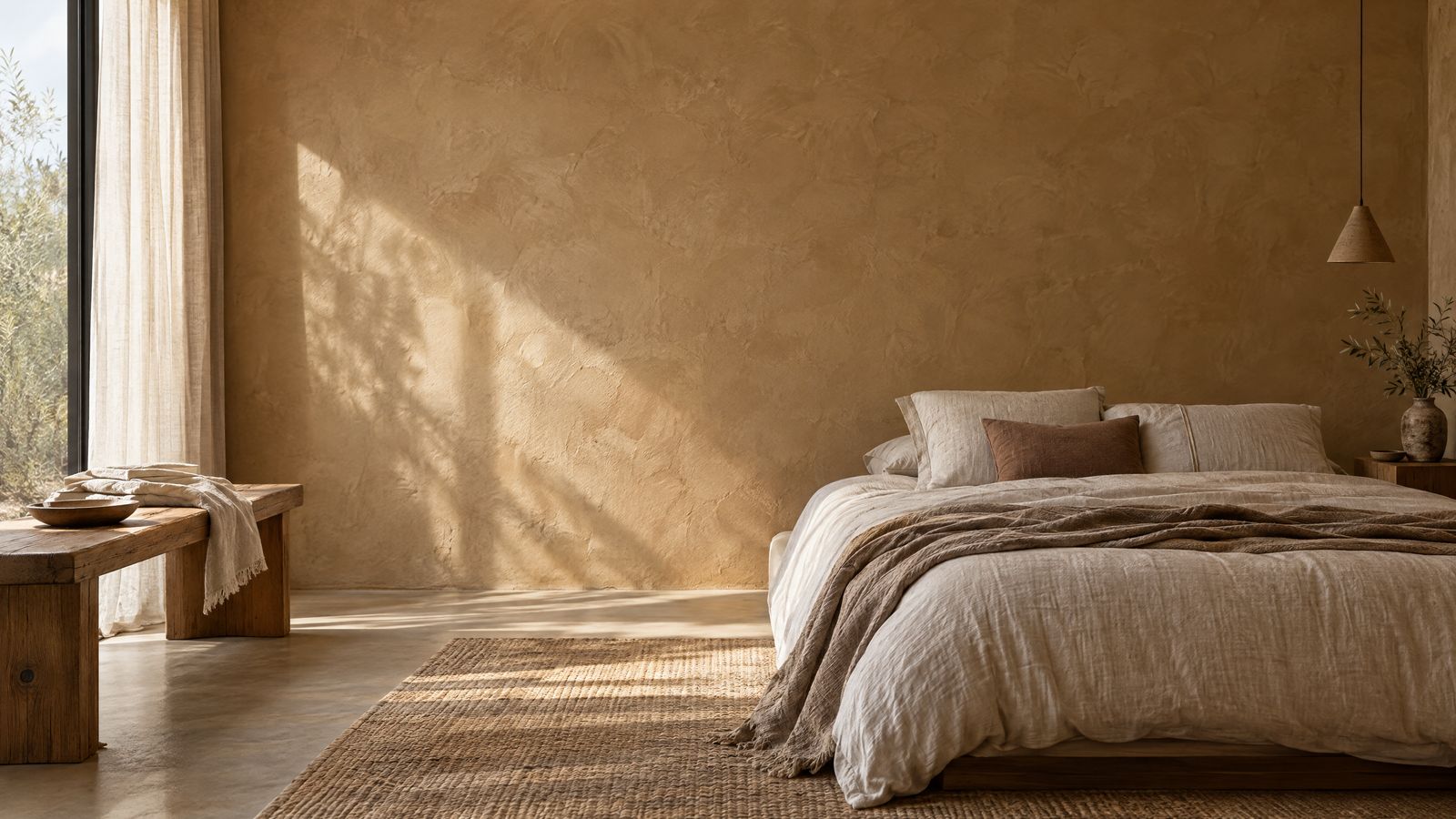
Decorative plaster is the umbrella name for hand-applied wall finishes: Venetian plaster, tadelakt, clay plaster and microcement. They differ in composition, sheen and how they behave in damp conditions. We install PANDOMO Clay decorative clay plaster, a matt, breathable wall of lime, clay and beeswax, and microcement on walls. We do not install tadelakt or Venetian plaster.
Key facts
- PANDOMO Clay decorative clay plaster is made of natural lime, clay and beeswax, with mineral pigments and no synthetic binder.
- The clay layer is 2 to 4 mm thick and is applied over gypsum, concrete and existing painted surfaces.
- Clay is dry to the touch in 24 hours, and further work can follow after 48 hours.
- The clay palette has eighteen named shades.
- Microcement on walls is applied in 5 to 7 layers, and the final layer is 1 to 2 mm thick.
What does decorative plaster actually mean?
Decorative plaster is the name for any wall finish applied by hand, with a trowel or spatula, instead of plain whitewash or paint. Very different materials are sold under that name: exterior and interior textured plasters, Venetian plaster, tadelakt, clay and microcement. So the first question is always what the plaster is made of.
When a shop or an advert says only "decorative plaster", that tells you nothing about its composition, its sheen or how the wall behaves in damp conditions. The same words can mean a thin textured coat for a hallway or a multi-layer finish for a bathroom.
The four finishes people ask about most
- Venetian plaster: a traditional finish based on lime and fine stone powder, burnished to a sheen that recalls marble.
- Tadelakt: a traditional lime-based finish from Morocco, burnished and sealed, and associated with bathrooms and hammams.
- Clay plaster: a matt, soft finish based on lime, clay and wax, which breathes and keeps humidity in balance.
- Microcement on walls: a cement-based mineral coating, in the same material as the floor, with no joints.
What is the difference between Venetian plaster, tadelakt, clay plaster and microcement?
Venetian plaster, tadelakt, clay plaster and microcement differ in composition, look and where they are used. Venetian plaster and tadelakt are traditional lime finishes with a sheen. Clay is matt and natural, and microcement joins wall and floor into one surface. The table shows the differences you can see and feel in a room.
| Venetian plaster | Tadelakt | Clay plaster (PANDOMO Clay) | Microcement on walls | |
|---|---|---|---|---|
| Base | Lime and fine stone powder | Lime | Lime, clay and beeswax, mineral pigments | Cement, in layers, with a topcoat |
| Look | Burnished, with depth and sheen | Burnished, soft sheen, visible handwork | Matt, soft, subtle variation in tone | Mineral, trowel marks, matt, satin or semi-gloss |
| To the touch | Smooth | Smooth | Soft, tactile surface | Smooth or with a stone grain, depending on the texture |
| Humidity in the room | Depends on the product and its protection | Traditionally associated with bathrooms | Absorbs excess moisture and releases it when the air is dry | With waterproofing it also goes into showers |
| Floor in the same material | Depends on the product | Depends on the product | No, the system is for walls and ceilings | Yes, in the same tone as the wall |
| Do we install it | No | No | Yes | Yes |
For Venetian plaster and tadelakt the information in the table is general, because it depends on the manufacturer and the craftsman. For clay and microcement we give what applies to the systems we install.
What is clay plaster and why choose it?
Clay plaster is a thin wall finish based on natural lime, clay and beeswax, coloured with mineral pigments. We install the PANDOMO Clay system. The layer is 2 to 4 mm thick, fully vapour permeable and free of synthetic binders. People choose it for its warm, matt look and because it keeps the humidity in a room in balance.
How clay works with humidity
Clay passively regulates the humidity in a room. It absorbs excess moisture from the air and releases it when the air turns dry. That is why it is chosen for bedrooms, wellness spaces and rooms where people spend a lot of time.
Look and colours
The surface is soft and tactile, with a subtle variation in tone and visible spatula marks. The palette has eighteen named shades, from dusty whites through sandy tones, greys and blues to deep earth tones, greens and purples. See every shade on the clay plaster page.
Durability and repairs
Clay is scratch resistant and easy to maintain. When the wall is damaged, the damage is filled in locally, with no visible join. The whole wall does not have to be redone.
What is tadelakt, and what is Venetian plaster?
Tadelakt is a traditional lime finish from Morocco, burnished by hand to a soft sheen and associated with bathrooms and hammams. Venetian plaster is a lime finish with fine stone powder, applied in thin layers and burnished to look like marble. We do not install either of these finishes.
We write about tadelakt and Venetian plaster because people compare them with clay and microcement when choosing a wall finish. The composition, the number of layers and the way they are protected vary from one manufacturer to another, so ask the contractor who installs a given product for its exact details.
When people choose clay or microcement instead of tadelakt
- When they want a matt wall with no sheen that still breathes: clay plaster.
- When they want the bathroom floor and walls to be one surface, with no joints: microcement.
- When the wall should be the same tone as the floor, a counter or a worktop: microcement.
Which decorative plaster suits which room?
The choice of decorative plaster depends on how damp the room is and whether the wall should continue into the floor. For bedrooms, living rooms and wellness spaces we most often suggest clay plaster. For bathrooms, showers and kitchens where the wall runs into the floor or the worktop, we suggest microcement.
| Room | What we suggest | Why |
|---|---|---|
| Bedroom | Clay plaster | A calm tone, quiet acoustics, a wall that keeps humidity in balance |
| Living and dining room | Clay plaster or microcement | Clay for a warm, matt wall, microcement when the wall continues into the floor |
| Kitchen | Microcement, or clay with protection | Microcement also goes behind the cooker and on the worktop, clay with extra protection where there is water |
| Bathroom and shower | Microcement | We put waterproofing under the microcement, so it also goes into the shower |
| Wellness and spa | Clay plaster | A wall that absorbs moisture and releases it when the air turns dry |
| Boutique hotel and commercial space | Clay or microcement | A wall that shows the handwork, with little upkeep |
Clay in the bathroom
Clay plaster can go into bathrooms and kitchens, and that is where its moisture regulation matters most. Surfaces directly exposed to water, such as a shower, need extra protection or a different material. We assess this before applying it. For a shower the answer is usually microcement.
Can clay plaster go over an existing wall and old paint?
Clay plaster is applied over gypsum, concrete and already painted surfaces, provided they are solid, dry and clean. Loose and damaged areas are removed first, and the wall is levelled and primed with an absorbent primer. The clay layer is 2 to 4 mm thick, so it does not change the dimensions of the room.
How we apply clay plaster
- Choosing the palette: sample tones on the wall, viewed under the room's natural and artificial light.
- Preparing the wall: we level the surface and prime it with an absorbent primer.
- Base coat: the first coat of clay is applied as a thin skim, to give an even base.
- Finish coat: the second coat gives the texture, with a fine or pronounced spatula mark.
We apply the final sample on your wall, under the light of the room. Clay is dry to the touch in 24 hours, and you should wait at least 48 hours before further work.
What should you check before choosing a decorative wall plaster?
Before choosing a decorative plaster, check what it is made of, whether it breathes, how it behaves in damp conditions and how it is repaired. The product name is not enough, because the same name is used for very different materials. Also ask the contractor exactly what preparing the wall involves.
- What is the plaster made of: lime, clay, cement or a synthetic binder?
- Does the wall still breathe after the finish is applied?
- Can it go in a kitchen or bathroom, and with what protection?
- How is damage repaired: locally, or across the whole wall?
- How is the wall maintained, and what must it never be cleaned with?
- Where can I see a sample before deciding?
A hand-applied wall takes experience. An unevenly applied layer and a badly prepared base show in the light, and a whole wall is hard to correct without redoing it. For clay or microcement on walls, send an enquiry through the clay plaster enquiry form, and if you are also choosing a floor, see which floor to choose.
Frequently asked questions
What is tadelakt?
Tadelakt is a traditional Moroccan lime wall finish, burnished by hand to a soft sheen and associated with bathrooms and hammams. We do not install tadelakt. When someone wants a matt wall that breathes, we suggest clay plaster, and for a shower, microcement.
Can clay plaster be used in a bathroom?
Yes, and that is where its moisture regulation matters most, because clay absorbs excess moisture and releases it when the air turns dry. Surfaces directly exposed to water, such as a shower, need extra protection or a different material. We assess this before applying it.
What is the difference between Venetian plaster and microcement?
Venetian plaster is a lime wall finish burnished to a sheen similar to marble. Microcement is a cement-based mineral coating that goes on both walls and floors with no joints, and with waterproofing into showers too. We install microcement, but we do not install Venetian plaster.
Can you wash a clay plaster wall?
A clay plaster wall is cleaned with a soft cloth or sponge and a mild detergent. Abrasive products and strong chemicals damage the top layer and are not used. Local damage is filled in, with no visible join.
Can clay plaster go over old paint?
Yes, if the existing paint is solid, dry and clean. Loose areas are removed, and the wall is levelled and primed with an absorbent primer. The clay layer is 2 to 4 mm thick, so it does not change the dimensions of the room.