Microcement, epoxy or terrazzo? Types of flooring compared
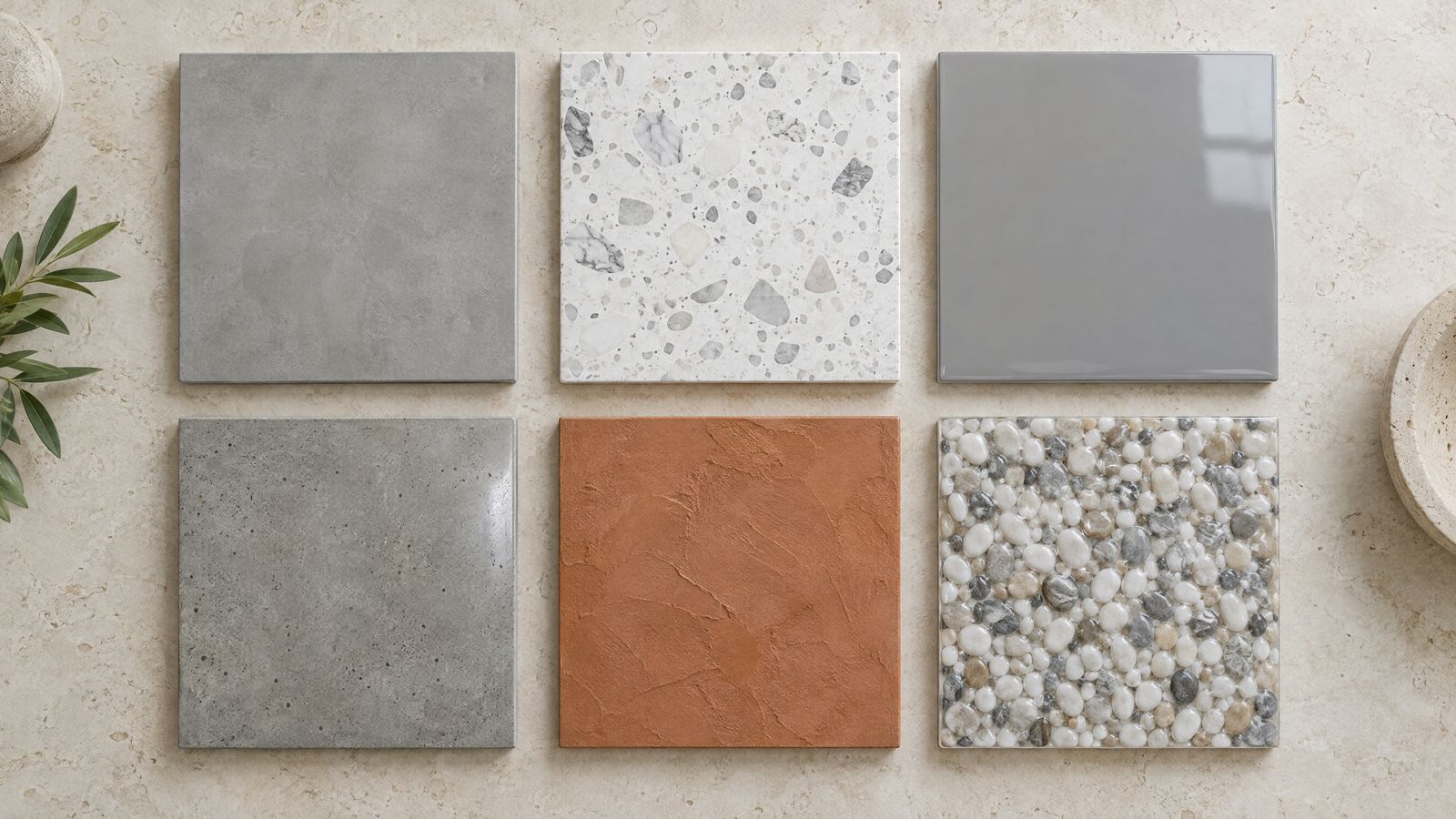
The right type of flooring depends on the space and the subfloor. Microcement goes over existing tiles without demolition, and into bathrooms. An epoxy floor takes heavier loads and is easy to disinfect, so it suits garages and commercial kitchens. Poured terrazzo lasts for decades. Polished concrete is made from the concrete slab itself. Stone carpet is for terraces and pool surrounds, and clay plaster for walls.
Key facts
- Microcement is applied by hand in 5 to 7 layers, and the final layer is 1 to 2 mm thick.
- An epoxy floor is 1.5 to 3 mm thick, and industrial systems go above 5 mm.
- We install poured terrazzo in three panDOMO systems, with a layer of 10 to 60 mm.
- Polished concrete is sealed with lithium silicate and is mainly for indoor spaces.
- Stone carpet comes in a permeable version for terraces, with pebbles of 2 to 12 mm.
What types of flooring are there and how do they differ?
The types of decorative flooring we install differ in material, layer thickness and the kind of space they are made for. Microcement and epoxy are thin layers with no joints, terrazzo is stone cast in a cement base, and polished concrete is a ground concrete slab. Stone carpet is for terraces, and clay plaster is for walls.
| Material | What it is made of | Layer | Where we use it most | When it wears |
|---|---|---|---|---|
| Microcement | Cement-based mineral coating, applied by hand | 5 to 7 layers, final layer 1 to 2 mm | Flats, bathrooms and showers, kitchens and worktops, offices, boutiques, outdoors too | The protective topcoat is renewed, with no demolition |
| Epoxy floor | Resin that is poured and levels itself | 1.5 to 3 mm, industrial systems above 5 mm | Garages, warehouses, commercial kitchens, laboratories, showrooms, lofts | Repaired, or a new layer is applied |
| Poured terrazzo | Marble, granite, stone or glass in a cement base | 10 to 60 mm, depending on the system | Entrances, living rooms, staircases, lobbies, public spaces | Ground and polished again |
| Polished concrete | Concrete slab, ground, polished and sealed with lithium silicate | Existing or new concrete slab | Offices, retail spaces, warehouses, lofts, indoors | Ground again instead of replaced |
| Stone carpet | Stone or marble pebbles in clear resin | Pebbles 2 to 12 mm | Terraces, pool surrounds, shower areas, spas, feature walls | Little upkeep, vacuuming and washing with warm water |
| Clay plaster | Lime, clay and beeswax | 2 to 4 mm, walls and ceilings only | Bedrooms, living spaces, wellness, boutique hotels | Repaired locally, with no visible join |
For the details of each system, its colours and patterns, see the pages on microcement, epoxy flooring, terrazzo, polished concrete, stone carpet and clay plaster.
Which flooring is best for each room?
For living rooms and bedrooms people most often choose microcement or poured terrazzo, for bathrooms microcement, for kitchens microcement or epoxy, for terraces stone carpet, and for garages an epoxy floor. What tips the decision is the subfloor you already have, the moisture in the room and the load the floor will carry.
| Space | What we suggest | Why |
|---|---|---|
| Living room | Microcement or poured terrazzo | Microcement goes over the existing floor, terrazzo brings character and a long life |
| Bathroom and shower | Microcement | We put waterproofing under the microcement, so floor, wall and shower become one surface |
| Kitchen | Microcement or epoxy | Microcement also goes on the wall and the worktop, epoxy into commercial kitchens |
| Entrance and staircase | Poured terrazzo or stone carpet | Terrazzo for entrances and staircases, stone carpet follows the shape of the stairs without cutting |
| Terrace and pool surround | Stone carpet | Lets water through, is not slippery, withstands frost and does not fade in the sun |
| Garage and warehouse | Epoxy floor | Withstands oil and chemicals, with the thickness set by the load |
| Office and shop | Microcement, polished concrete or epoxy | A smart, presentable surface that needs little upkeep |
For some spaces we have separate guides: microcement or tiles in the bathroom and flooring for terraces.
Microcement vs epoxy flooring, which is right for you?
Microcement and epoxy are both thin floors with no joints, but they suit different spaces. Epoxy carries heavier loads and is easier to disinfect, so it goes into warehouses, garages, kitchens and laboratories. Microcement is applied over the existing floor and has a mineral look, so it goes into homes, bathrooms, boutiques and offices.
Subfloor
Microcement goes over tiles, plasterboard, wood, marble or terrazzo, as long as the surface is solid. Epoxy needs a hard, solid base, above all concrete, and with preparation it can also go on stone or marble. Wood is not a good base for epoxy, because it shrinks and expands, and over time the epoxy layer cracks. There is more on this in microcement over tiles.
Look
Microcement is made by hand, with trowel marks and a slight variation in tone. Epoxy flows out into a level surface, in a full range of colours, and as a decorative floor with flake blends and marbled effects. Both come in a matt, satin or semi-gloss finish.
When you can use the floor
You can walk on an epoxy floor 24 to 72 hours after the last coat. Installing the basic microcement system takes at least five days, plus preparing the subfloor. What sets the price of each is covered in what microcement costs and epoxy floor prices.
When does polished concrete make sense?
Polished concrete makes sense when the space already has a concrete slab or a new one is about to be poured, most often in offices, retail spaces, warehouses and loft apartments. The slab is ground in several stages, sealed with lithium silicate and polished to the chosen sheen. It is mainly for indoor spaces, not terraces.
- Sheen of your choice: matt honed, satin or high gloss.
- Tones from light grey to graphite. Pigment can be added to the mix, or the surface tinted after pouring.
- Maintenance is dry cleaning and an occasional wipe with a damp mop.
- We do both the screed and the finish, so responsibility is never passed back and forth between two contractors.
Polished concrete is not for outdoor surfaces, because a polished surface is slippery when wet. For terraces and pool surrounds we suggest stone carpet.
Terrazzo or stone carpet, when to choose which?
Poured terrazzo and stone carpet both show natural stone, but in different ways. Terrazzo is poured, ground and polished to a smooth surface, for entrances, staircases and lobbies that need to last for decades. Stone carpet leaves rounded pebbles bound in resin, which you can feel underfoot, for terraces, pools and shower areas.
Poured terrazzo
We install three panDOMO Terrazzo systems, Basic, Microterrazzo and Plus, with sixteen archive patterns and mixes made for the project. We explain the difference between poured terrazzo and ready-made tiles in poured terrazzo or terrazzo tiles.
Stone carpet
We install the ARDEX stoneCARPET system. Outdoors we use the open, permeable version that drains water by itself, and indoors the closed, polished version. What affects the price, and when not to do it yourself, is covered in stone carpet.
What goes on walls, microcement or clay plaster?
Walls most often get microcement or clay plaster. Microcement is chosen when the wall should continue into the floor with no threshold and no joint, especially in bathrooms and kitchens. PANDOMO Clay decorative clay plaster is chosen for a warm, matt wall that breathes and keeps the humidity in the room in balance.
The clay comes in eighteen named shades and is applied over gypsum, concrete and already painted surfaces. For a comparison of clay with Venetian plaster and tadelakt, read decorative plaster, tadelakt or clay.
What should you ask a contractor before choosing a floor?
Before choosing a floor, ask the contractor what is under your existing floor and how it will be prepared, which system they install and how thick, what the floor needs in wet areas and how it is renewed when it wears. The same questions apply to homeowners and to architects writing a specification.
- What subfloor is needed and what does preparing it involve?
- Which system is installed, from which manufacturer and how thick?
- How does the floor behave in a bathroom, a kitchen or outdoors?
- How is the colour chosen, and where can I see a sample before deciding?
- How is the floor maintained, and what must it never be cleaned with?
- How is the floor renewed after several years, and does that involve demolition?
- Which projects in this material can I see in person or in photos?
How microcement holds up after years of use is covered in microcement, real experiences, and you can browse our completed projects. If you are not sure what you need, describe the space through the contact form and we will suggest a system.
Frequently asked questions
What is the best flooring for a kitchen?
For a kitchen at home we most often suggest microcement, because it can be the floor, the wall behind the cooker and the worktop in one tone, with extra protection on the worktop. For commercial kitchens we suggest an epoxy floor, which withstands chemicals and is easy to disinfect.
What flooring can go over tiles?
Microcement goes over existing tiles, with no demolition and no breaking out, provided the tiles are solid and do not rock. It is applied in 5 to 7 layers, and the final layer is 1 to 2 mm thick. Poured terrazzo can go over an existing floor only if the base can take a thicker layer.
Which flooring has no joints?
Microcement, epoxy floors and stone carpet have no joints. Poured terrazzo has no joints between tiles, but on large areas it has expansion profiles as the project requires. Microcement can also join floor and wall into one surface, with no threshold.
Which is cheaper, epoxy or microcement?
That depends on the subfloor, the area, the use and the preparation, so there is no single answer. Epoxy and microcement are chosen by the space, not by the price per square metre of material. Compare quotes for the whole job, with every item, for the same space.
What flooring looks like concrete but is not concrete?
Microcement gives the mineral look of concrete in a thin layer, with a final layer 1 to 2 mm thick, and it goes over existing tiles. Polished concrete is real concrete, a ground and polished concrete slab sealed with lithium silicate.