Poured terrazzo vs terrazzo tiles, differences, look and cost
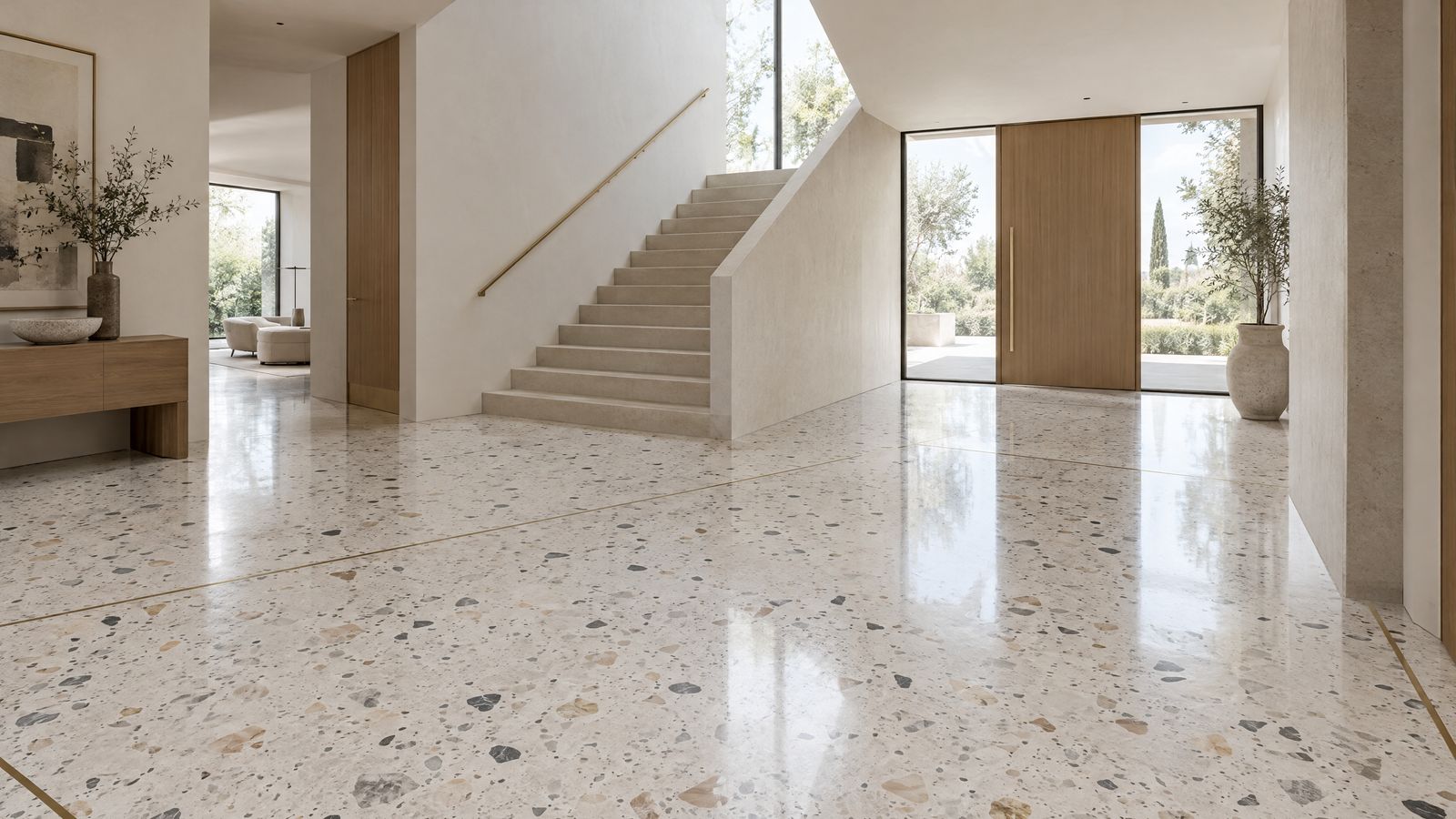
Poured terrazzo is poured, ground and polished on site, in one piece with no joints between tiles. Terrazzo tiles are ready-made factory tiles, fixed like ordinary tiles and with grout lines. Poured terrazzo gives more freedom in choosing the aggregate and the colour of the base, and it is renewed by grinding. We install poured terrazzo, in three panDOMO Terrazzo systems: Basic, Microterrazzo and Plus.
Key facts
- Terrazzo is a floor of marble, granite, natural stone or glass chips bound in a cement base.
- We install three panDOMO Terrazzo systems: Basic (25 to 60 mm layer), Microterrazzo (10 to 20 mm) and Plus (25 to 50 mm).
- Compressive strength is 45 to 60 N/mm² after 28 days, depending on the system.
- Our range includes sixteen archive patterns, plus mixes tailored to the project.
- When it wears after many years, terrazzo is ground and polished again, with no demolition.
What is terrazzo flooring?
Terrazzo is a floor made of marble, granite, natural stone or glass chips bound in a cement base. The mix is poured and, once it has hardened, ground and polished until the chips open up and the surface is smooth. A factory terrazzo tile can have the same look, but it is made and installed differently.
The chips you see on the surface are called the aggregate. This is the stone or glass that gives the floor its colour and character. The base that holds them is called the matrix. The ratio between the two, the size of the chips and the colour of the matrix decide how the floor will look.
What is the difference between poured terrazzo and terrazzo tiles?
Poured terrazzo is made on site: the mix is poured onto a prepared base, then ground and polished into one surface. Terrazzo tiles are made in a factory, in standard sizes, and fixed with adhesive like ordinary tiles, with grout lines. The difference shows in the joints, the choice of pattern, the thickness and how the floor is renewed.
| Poured terrazzo | Terrazzo tiles | |
|---|---|---|
| Where it is made | On site, poured, ground and polished | In a factory, as a finished tile |
| Joints | No joints between tiles, only expansion profiles as the project requires | A grout line between every tile |
| Format | One piece, even on large areas | The manufacturer's standard sizes |
| Choice of pattern | Matrix colour and the type and density of aggregate are chosen for the project | From the manufacturer's catalogue |
| Thickness | With us 10 to 60 mm, depending on the system | Depends on the manufacturer and the size |
| Installation | Pouring, grinding in several stages, polishing, impregnating sealer | Fixing with adhesive and grouting, like tiles |
| Renewal | The whole surface is ground and polished again | Depends on the tile, and the grout lines are renewed separately |
The terrazzo tile column is general, because we do not install tiles and every manufacturer has its own sizes and instructions. For poured terrazzo we give what applies to the systems we install.
Which poured terrazzo systems do we install?
We install three panDOMO Terrazzo systems, which differ in layer thickness, grain size and the load they carry. Terrazzo Basic has the most character, Microterrazzo is thinner and more even, and Terrazzo Plus is made for heavier wear. We choose the system according to the space, the subfloor and how much foot traffic it gets.
| System | Layer thickness | Aggregate | When we choose it |
|---|---|---|---|
| Terrazzo Basic | 25 to 60 mm | Local river aggregate, 0 to 8 mm | When you want the most character and pronounced stone |
| Microterrazzo | 10 to 20 mm | Up to 4 mm, can include recycled materials | When you want a thinner layer and a more even surface |
| Terrazzo Plus | 25 to 50 mm | To suit the project | When you need a strength of 60 N/mm² and higher wear resistance |
See the details of each system and all the patterns on the terrazzo floors page.
What does poured terrazzo look like compared with terrazzo tiles?
Poured terrazzo looks like one continuous stone surface, with the aggregate running from wall to wall. Terrazzo tiles give a similar pattern of chips, but grout lines cut through it, so you see the grid of tiles. With poured terrazzo we choose the matrix colour, aggregate and density for the project, not from a catalogue of ready-made tiles.
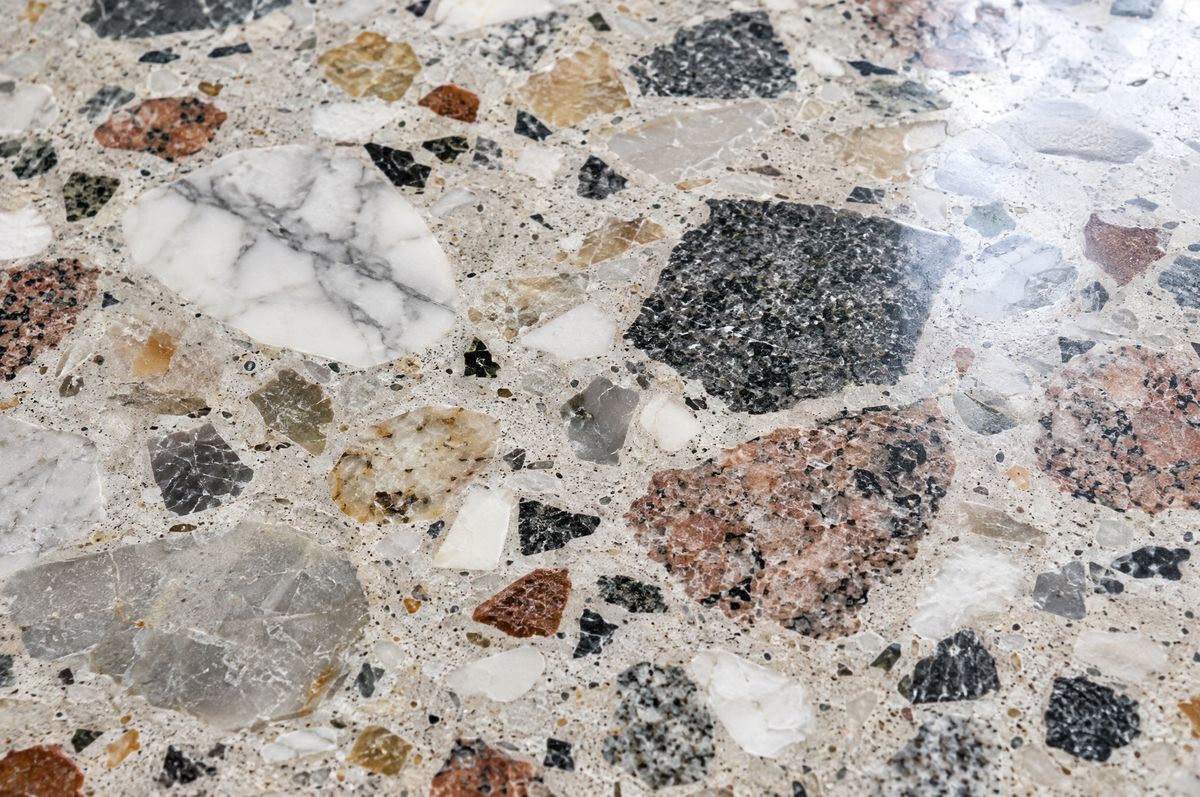
Aggregate and matrix colour
The aggregate can be marble, granite, glass or recycled filler. The matrix ranges from light to dark, and the chips from fine and even to coarse and pronounced. The choice is confirmed on a sample before pouring.
Sixteen patterns as a starting point
We offer sixteen archive panDOMO Terrazzo patterns: nine for Basic, four for Micro and three for Plus. Alongside them we make mixes for a specific project. You can see the samples in person at our showroom.
Joints and expansion profiles
Poured terrazzo has no joints between tiles, but large areas have expansion profiles. These are thin strips that divide a large surface into fields, so the floor can follow movement in the structure without cracking. They are set before pouring, so they become part of the floor's design.
What affects the cost of a terrazzo floor?
The cost of poured terrazzo depends on the area, the chosen system and how much of the subfloor needs preparing. Basic, Micro and Plus differ in layer thickness and the load they carry, so they also differ in price. We give a quote after visiting the space and making samples, because only then is it clear what the subfloor needs.
What the cost of poured terrazzo includes
- Making samples: matrix colour, type and density of aggregate, grain size.
- Preparing the floor: pouring a reinforced screed as the base and setting the expansion profiles.
- Pouring: mixing the aggregate and matrix by hand and spreading them across the surface.
- Grinding in several stages, coarse and fine, with touch-ups in grout of the same tone where needed.
- Final polishing to the chosen sheen and protection with an impregnating sealer.
How to compare it with tiles
Poured terrazzo and terrazzo tiles should be compared on the price of the whole job, not the price per square metre of material. With tiles the job includes adhesive, grouting and cutting, and with poured terrazzo the subfloor preparation, grinding and polishing. Lifespan and how the floor is renewed are part of that sum.
Where does poured terrazzo make sense, and where do terrazzo tiles?
Poured terrazzo makes sense where you want a long life, the character of the material and a surface with no joints: entrances, living rooms, staircases, hotel lobbies, restaurants and public spaces. Terrazzo tiles are usually chosen when you want a ready-made format from a catalogue, installed the way tiles are.
Where we install poured terrazzo
- Homes: entrances, living rooms and staircases.
- Hospitality: lobbies, reception desks, arrival areas and restaurants.
- Retail: shop floors and shop windows, as a quiet, long-lasting floor beneath the displays.
- Public spaces: schools, hospitals, galleries and cultural institutions.
For terraces and outdoor surfaces, read which floor to choose for a terrace, and for terrazzo compared with other floors, see types of flooring.
Can terrazzo go over an existing floor?
Poured terrazzo can go over an existing floor, under certain conditions. The base must be solid, level and well prepared, and it must take the extra layer thickness, which with us is 10 to 60 mm, depending on the system. Whether your floor meets these conditions is assessed on site.
If the extra height is not possible, because of doors, thresholds or transitions to other rooms, the answer is the thinner Microterrazzo or another material. Microcement in the Micro-Stone texture has a coarser grain, close to terrazzo, and is applied over existing tiles in 5 to 7 layers, with a final layer 1 to 2 mm thick.
For an estimate, send the location, the approximate area and photos of the existing floor through the terrazzo enquiry form.
Frequently asked questions
How much does terrazzo cost per square metre?
The price of terrazzo per square metre depends on the area, the chosen system and the subfloor preparation. Basic, Micro and Plus differ in thickness and load, and so in price. We give a quote after visiting the space and making samples. Send us the location and the approximate area and we will come back with an estimate.
Is poured terrazzo more expensive than terrazzo tiles?
That depends on what you compare. The price per square metre of material says little, because with tiles the job includes fixing and grouting, and with poured terrazzo the subfloor preparation, grinding and polishing. Compare quotes for the whole job, and how each floor is renewed after several years.
Can terrazzo be used outdoors?
We list the poured terrazzo we install for entrances, living rooms, staircases, lobbies and public spaces. For terraces and pool surrounds we suggest stone carpet, which lets water through, is not slippery and withstands frost.
How do you maintain a terrazzo floor?
Polished terrazzo needs little maintenance and resists scratches and stains. After polishing, the surface is protected with an impregnating sealer. When it wears after many years, terrazzo is ground and polished again, without demolishing the existing surface.
Can terrazzo be restored by polishing?
Poured terrazzo is restored by grinding and polishing it again, with no demolition, and afterwards it looks like new. That is why it is most often chosen for entrances, staircases and hotel lobbies, where a floor needs to last for decades.