Best flooring for a terrace, stone carpet, tiles, terrazzo or epoxy
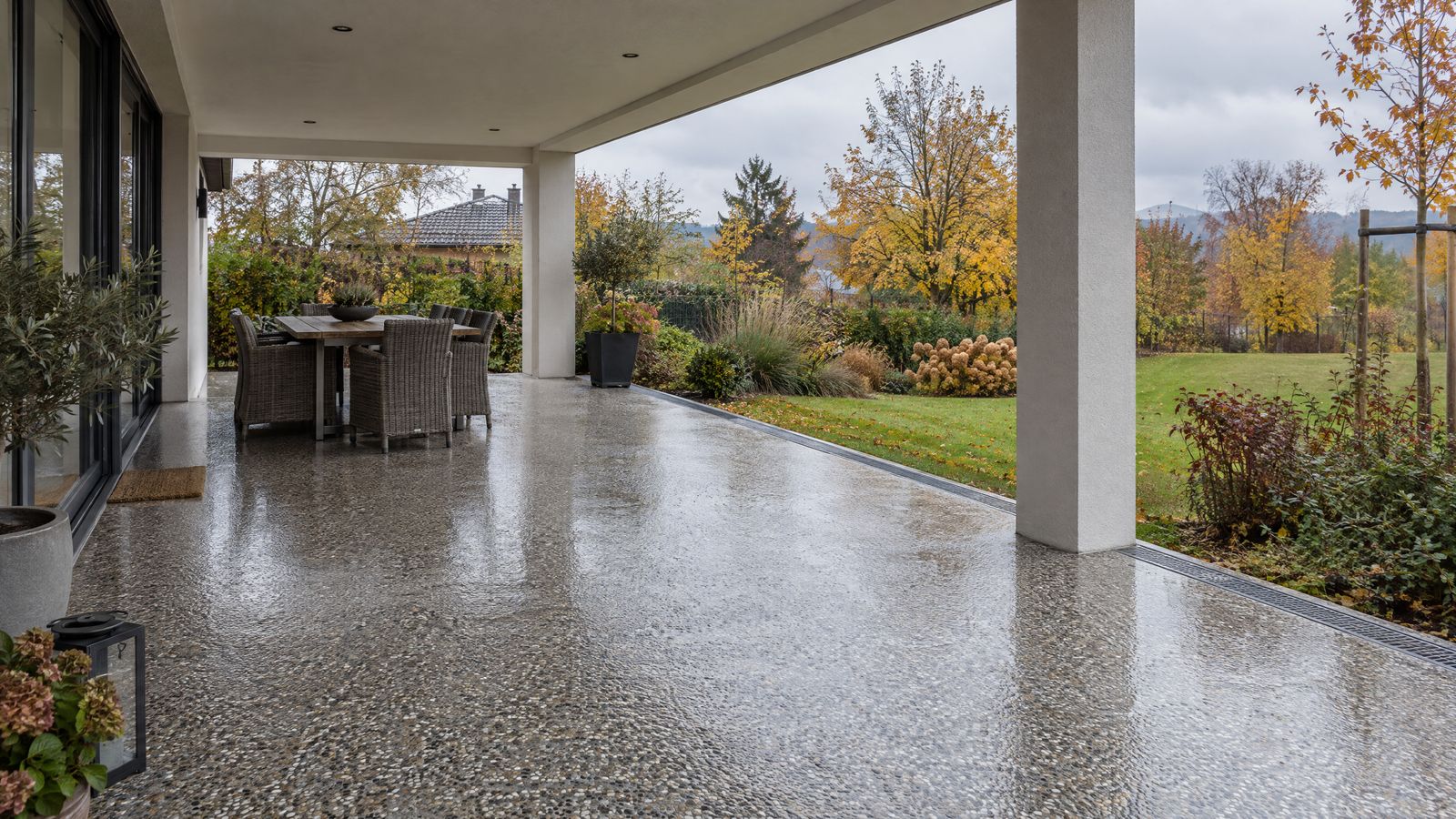
The best flooring for an open terrace drains water, is not slippery when wet and withstands sun and frost. Of the materials we install, we suggest stone carpet in its permeable version for terraces: water passes through the layer, and the surface is UV stable and frost resistant. Tiles are a common choice, but they have joints. We suggest terrazzo, epoxy and polished concrete for indoor spaces.
Key facts
- Outdoor stone carpet has an open, permeable structure, so the terrace has no puddles and needs no drain.
- The surface of stone carpet is not slippery when wet, is UV stable and resists frost and temperature swings.
- Before installing stone carpet on a terrace, we do the waterproofing and check the drainage slope.
- Polished concrete is not for outdoor surfaces, because a polished surface is slippery when wet.
- We do not install tiles, wood or WPC decking, so we compare them here in general terms.
What is the best flooring for an open terrace?
The best flooring for an open terrace is one that deals with water, slipping, sun and frost. Of the materials we install, we suggest stone carpet for terraces, because water passes through the layer and it is not slippery when wet. Tiles are the most common choice, but they have joints where dirt collects.
Six questions before choosing terrace flooring
- Where does the water go: through the floor, down the slope to a drain, or nowhere?
- Is the surface slippery when wet?
- Does the material withstand sun, frost and big swings in temperature?
- Are there joints and seams where dirt collects?
- What is underneath: waterproofing, concrete or old tiles?
- How much maintenance are you prepared to do?
How do stone carpet, tiles, terrazzo, epoxy and wood compare on a terrace?
Stone carpet, tiles, terrazzo, epoxy and wood or WPC decking differ most in how they drain water and whether they have joints. The table below compares them on what matters on an open terrace. For tiles and wood we give general properties, because these depend on the specific product.
| Water | Joints and seams | Sun and frost | What we offer for terraces | |
|---|---|---|---|---|
| Stone carpet, outdoor version | Passes through the layer, no puddles | No joints | UV stable, frost resistant | Yes, this is our recommendation for terraces |
| Tiles | Runs off the surface, along the slope | Joints between the tiles | Depends on the tile class and frost resistance | We do not install tiles |
| Poured terrazzo | Closed surface | No joints, with expansion profiles | Our applications are indoors | We suggest it for interiors |
| Epoxy floor | Closed surface, water runs off along the slope | No joints | Our applications are indoors and in garages | We suggest it for homes, shops and garages |
| Polished concrete | Slippery when wet | No joints | Not for outdoor surfaces | We do not install it outdoors |
| Wood and WPC decking | Drains through the gaps between boards | Gaps between boards | Depends on the material and upkeep | We do not install it |
Why do we recommend stone carpet for terraces?
We recommend stone carpet for terraces because the outdoor version has an open, permeable structure. Water passes through the layer, so no puddles form and no drain is needed. The surface is not slippery when wet, does not fade in the sun, withstands frost and temperature swings and is installed in one piece.
Stone carpet follows the shape of a terrace or staircase without cutting and without visible seams. The same material can run from the terrace onto the steps and around the pool, so the whole outdoor area stays one surface.
We install the ARDEX stoneCARPET system, with natural stone or marble pebbles. What sets the price, how to maintain it and where DIY jobs most often go wrong is explained in stone carpet, cost and experience. The system and pebble colours are on the stone carpet page.
When are tiles a good choice for a terrace?
Tiles are a good choice for a terrace when they are made for outdoor use, frost resistant and anti-slip, and when the terrace has a proper slope and waterproofing. We do not install tiles, so we describe them here in general terms. The main differences from stone carpet are the joints, and that water runs off the surface.
On an open terrace the joints need attention, because they are constantly exposed to water, sun and frost. Dirt also collects in them, so a tiled terrace is cleaned differently from a surface with no joints.
If the existing tiles on your terrace are solid but you do not like the look, it does not always all have to come up. That is covered in the section on old tiles, further down.
Can epoxy or terrazzo be used on a terrace?
We suggest the epoxy and terrazzo in our range for indoor spaces, and stone carpet for open terraces. We install epoxy in homes, shops, kitchens and garages, and terrazzo in entrances, living rooms, staircases, lobbies and public spaces. Both are closed surfaces, so water does not pass through the layer.
Epoxy floor
An epoxy floor is one surface with no joints, resistant to wear, oil and chemicals, which makes it a good choice for a garage. What sets the price of epoxy, and how a home, a shop and a garage differ, is covered in epoxy floor prices.
Poured terrazzo
Poured terrazzo is a floor of marble, granite or glass chips in a cement base, poured, ground and polished on site. It lasts for decades and is ground again when it wears. All the uses we list for terrazzo are indoors.
Polished concrete
Polished concrete is not for outdoor surfaces. A polished surface is slippery when wet, so outdoors concrete is given a rougher finish, or a material made for exteriors is chosen.
Can a new floor go over old tiles on a terrace?
A new floor over old tiles on a terrace is an option only if the tiles are solid and the terrace has a proper slope and waterproofing. If tiles rock, or water stands on the terrace or gets into the room below, the problem is under the tiles and must be solved before any new floor goes down.
For stone carpet we inspect the subfloor on site. Preparation includes exterior waterproofing, priming and checking the drainage slope, so after the inspection we know whether the old tiles can stay or must come up.
Signs that the problem is under the tiles
- The tiles sound hollow when you tap them.
- Some tiles rock or have come loose.
- The grout lines are cracked or partly missing.
- After rain, water stands in the same places.
- Damp stains show on the ceiling of the room below the terrace.
What has to be done before any floor goes onto a terrace?
Before any floor goes onto a terrace, three things must be sorted: waterproofing, the drainage slope and expansion joints. The top layer, whether tiles, stone carpet or decking, replaces none of them. If something underneath is missed, the problem will show even through the best finished floor.
Waterproofing
Waterproofing stops water getting into the structure and into the room below. On a terrace above a flat or a garage, it matters more than how the floor looks.
Drainage slope
The slope carries water to the edge or to a drain. With stone carpet, water passes through the layer, but beneath the layer it still needs somewhere to go. That is why we check the slope before installation.
Expansion joints
Expansion joints let the structure expand and contract with temperature. On an open terrace the difference between summer and winter is large, so the expansion joints in the structure must also be respected in the finished floor.
For a terrace inspection and a quote for stone carpet, send the location, the approximate area and photos of the existing floor through the enquiry form. A comparison of all the floors we install for indoor spaces is in which floor to choose.
Frequently asked questions
Is stone carpet slippery in winter?
Stone carpet is not slippery when wet, and water passes through the open structure instead of staying on the surface. The system resists frost and temperature swings. Ice is slippery on any surface, so in winter the terrace is cleared like any other.
Can epoxy be used on a terrace?
We suggest the epoxy in our range for homes, shops, kitchens and garages, and stone carpet for open terraces. An epoxy floor is a closed surface, so water only runs off along the slope. Tell us what your terrace is like and we will suggest a solution.
Which flooring does not crack in frost?
The stone carpet we install resists frost and temperature swings. Terrace tiles should be made for outdoor use and frost resistant. The same applies to every floor: if water stays under the top layer and freezes, the problem starts in the subfloor.
Does stone carpet on a terrace need a drain?
The open structure of stone carpet lets water through the layer, so no puddles form and no surface drain is needed. Beneath the layer the water still needs somewhere to go, which is why we waterproof and check the slope before installation.
Can stone carpet go on terrace steps?
Yes. Stone carpet is installed in one piece and follows the shape of the terrace or staircase without cutting and without visible seams. Steps take more hand work than a flat surface, so they are listed separately in the quote.