Stone carpet flooring, cost, performance and when not to DIY
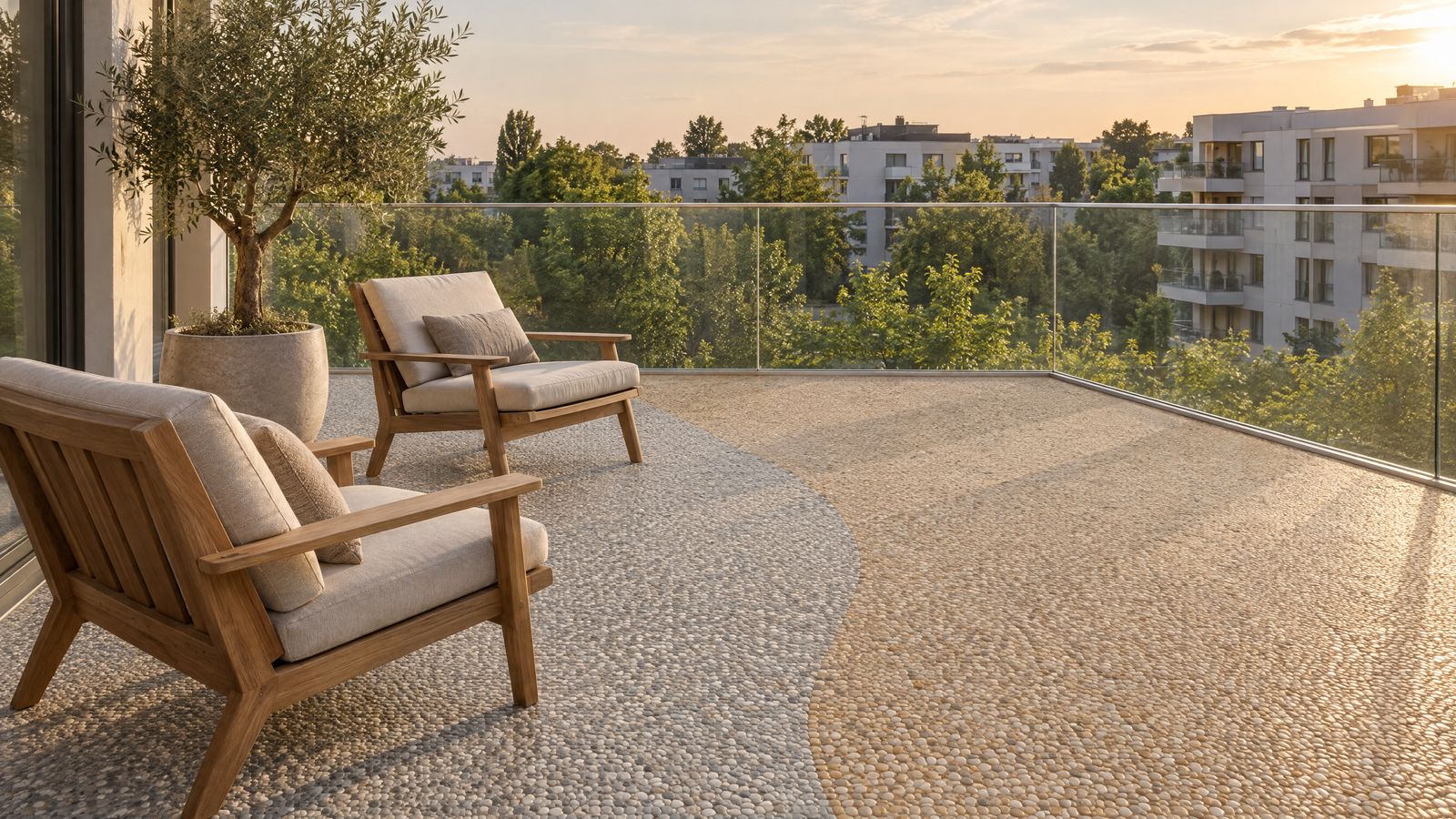
The installed cost of stone carpet flooring depends on the condition of the subfloor, the waterproofing and drainage slope, the type and size of the pebbles, the shape of the area and its size. Outdoors we use the open, permeable version, indoors the closed, polished one. We install the ARDEX stoneCARPET system. We give an exact price after inspecting the subfloor, in a written quote listing all the work.
Key facts
- Stone carpet is made of natural stone or marble pebbles, bound with clear resin into one surface with no joints.
- We install the ARDEX stoneCARPET system, with pebbles in calibrated sizes of 2 to 4, 4 to 8 and 8 to 12 mm.
- Outdoors we use the open, permeable version, and indoors the closed, polished version.
- The surface is not slippery when wet, is UV stable and resists frost and temperature swings.
What affects the installed cost of stone carpet flooring?
The installed cost of stone carpet depends on five things: the condition of the subfloor, waterproofing and the drainage slope, the type and size of the pebbles, the shape of the area and its size. The subfloor matters most, and only on site can we see what it needs. That is why we give no price per square metre unseen.
The subfloor and its preparation
Stone carpet is installed on a solid, prepared base. Before installation we prime the subfloor, and any damage is repaired before the first layer. Concrete in good condition needs less work than a cracked screed or a terrace with loose tiles.
Waterproofing and the drainage slope
On terraces and around pools we put waterproofing under the stone carpet and check the slope for drainage. The open structure lets water through the layer, but beneath the layer the water still has to go somewhere. If the terrace has no slope or no waterproofing, that is fixed before installation and included in the quote.
The pebbles, mineral, colour and size
The pebbles are natural stone or marble, in calibrated sizes of 2 to 4, 4 to 8 and 8 to 12 mm. Mineral, colour and grain size set the look of the surface, so they are chosen together with the use. We confirm the choice on a sample before installation.
The shape of the area
A flat terrace is the simplest case. Steps, pool edges, skirtings and walls take more hand work, because the mix is spread and levelled with a trowel along every edge. Stone carpet follows the shape without cutting, but every edge is extra work.
The size of the area
A small area costs more per square metre than a large one. Preparation, getting the crew to site and mixing the material do not shrink in proportion to the area. So a balcony of a few square metres does not cost the same per metre as a large terrace or courtyard.
| Item | What it covers | What it depends on |
|---|---|---|
| Subfloor preparation | Cleaning, repairing damage and priming | The condition of the concrete, screed or existing tiles |
| Waterproofing and slope | A waterproof layer underneath and checking the slope for drainage | Whether the work is outdoors and what the existing slope is |
| Material | Pebbles and clear resin in a measured ratio | The mineral, colour and size of the pebbles, and the area |
| Installation by hand | Mixing, spreading and levelling with a trowel | The shape, flat surface, steps, pool edges, wall |
| Version | Open and permeable, or closed and polished | Whether the surface is outdoors or indoors |
Why is the price of the materials not the price of an installed stone carpet?
The material price for stone carpet covers the pebbles and the resin, not the finished floor. It does not include preparing the subfloor, waterproofing, the drainage slope, installation by hand or the work on edges and steps. That is why the price of a bag or a kit cannot be compared with a contractor's price per square metre.
With a contractor you also pay for what you cannot see: the inspection of the subfloor, the exact ratio of resin to pebbles and the experience to spread the mix before the resin sets. That decides whether the surface stays solid after several seasons.
Before you compare two quotes, check what each one includes.
- Is subfloor preparation included, and what exactly does it cover?
- Are waterproofing and checking the slope on the terrace included?
- What type and size of pebbles are specified?
- Are steps, skirtings and edges listed separately?
- Is the permeable version specified for an outdoor surface?
Can you install stone carpet yourself?
You can install stone carpet yourself on a small, flat area with a good base, but it is hand work that does not forgive mistakes. The pebbles and resin are mixed in an exactly measured ratio, and the mix is spread and levelled before the resin sets. A mistake in preparation or mixing often shows only later.
Where people most often go wrong
- The subfloor is not prepared. Loose material, dust and tiles that have come unstuck stay underneath, so the layer does not hold.
- There is no slope and no waterproofing. Water passes through the open structure, but has nowhere to go underneath.
- The wrong ratio of resin to pebbles. With too little resin the pebbles do not bind, and with too much the open structure closes up.
- Mixing in batches without a plan. Each batch has to be spread while the resin is still workable, or the joins show.
- Walking on it too early. The surface takes foot traffic only once the resin has cured.
When it is better to call a contractor
Call a contractor if the job is a terrace above a room, a pool surround, a staircase or a surface with no slope. In those cases the life of the floor depends on the waterproofing and drainage underneath, and a mistake under the layer cannot be fixed without removing the layer.
How does outdoor stone carpet differ from indoor stone carpet?
Stone carpet outdoors and stone carpet indoors are not the same surface. Outdoors we use the open, permeable version, which water drains through by itself, so no drain is needed. Indoors we install the closed, polished version, on floors and feature walls in hotels, restaurants and healthcare facilities.
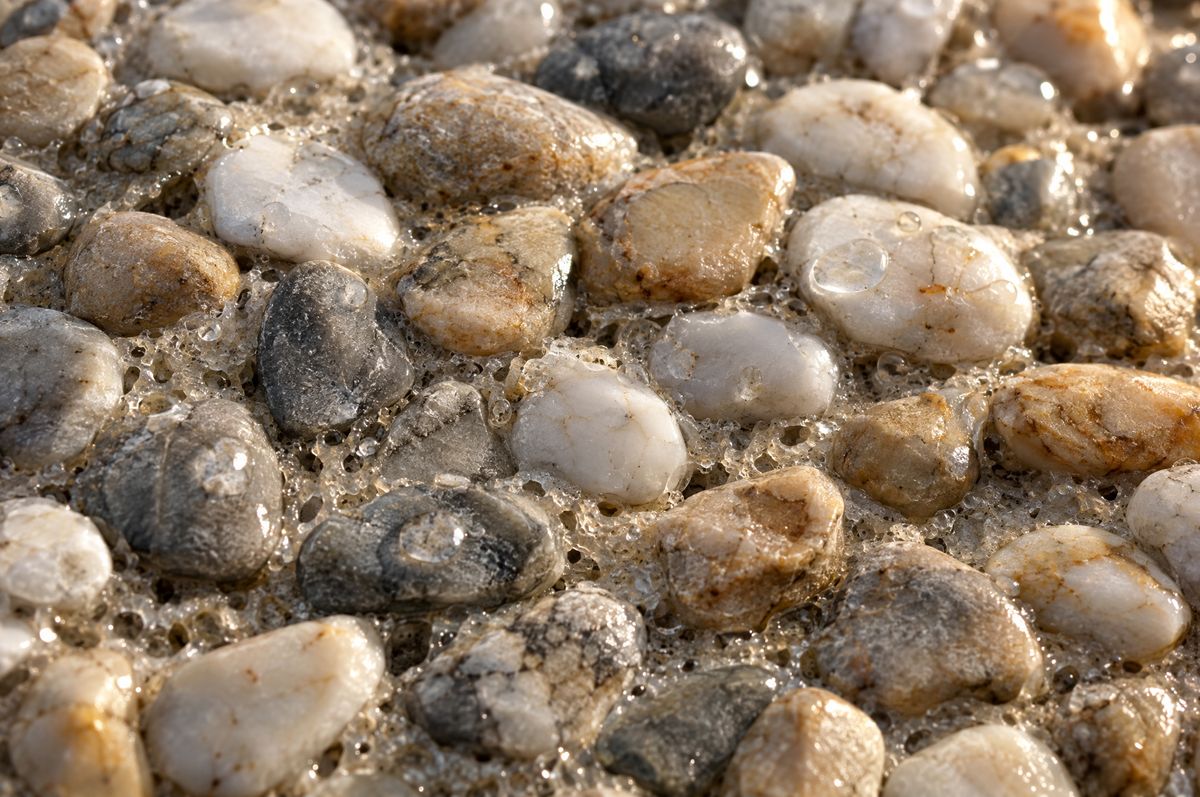
| Outdoors | Indoors | |
|---|---|---|
| Structure | Open, permeable | Closed, polished |
| Subfloor preparation | Waterproofing, priming and checking the slope | A prepared and primed subfloor |
| What the surface must do | Let water through, stay non-slip, withstand sun and frost | A hygienic surface with no joints, resistant to wear and stains |
| Typical places | Roof and ground-level terraces, courtyards, pool surrounds | Hotels, restaurants, spas, feature walls |
For a terrace, also read which floor to choose for a terrace, where we compare stone carpet with tiles, terrazzo and epoxy. We compare floors for indoor spaces in which floor to choose.
How does stone carpet perform on terraces and around pools?
Stone carpet performs best where water is always present: open terraces, pool surrounds and outdoor shower areas. The surface is not slippery when wet, does not fade in the sun and withstands frost. When a problem does appear, the first things to check are the subfloor, the slope and the ratio of resin to pebbles.
Where stone carpet works well
- Terraces without a drain, because water passes through the layer and no puddles form.
- Pool surrounds, because the surface is not slippery and you can feel the stone under bare feet.
- Staircases and irregular terraces, because it is installed in one piece, without cutting.
- High-traffic spaces, because it withstands wear, chemicals and stains.
What to know in advance
- The surface is not as smooth as a tile. You feel the stone underfoot, and that is part of the material.
- With the open version, dust and leaves can collect between the pebbles, so regular dry vacuuming is needed.
- Without a slope and waterproofing underneath, water that passes through the layer has nowhere to go.
- Pebble colours on screen are approximate, so the choice is confirmed on a sample.
How do you clean and maintain stone carpet?
Stone carpet is maintained by dry vacuuming and occasional washing with warm water, both outdoors and indoors. With the open version outdoors, water passes through the layer, so you can also hose the terrace down. The surface withstands chemicals and stains, so harsh cleaning products are not needed.
Regularity helps most. Leaves, sand and dust come off more easily while they are dry and on the surface than after rain has washed them in between the pebbles.
How do you get a quote for stone carpet?
We give a quote for stone carpet after inspecting the subfloor, because the preparation, waterproofing and slope depend on it. From the area alone we can outline the scope of work, but not the price. The quote is written and lists every item, so you know in advance what you are paying for.
- Send us the location, the use (terrace, pool, staircase, wall) and the approximate area.
- We arrange an on-site inspection of the subfloor and the slope.
- You choose the colour, mineral and pebble size. We make a sample with a trial joint on site, on your subfloor.
- You receive a written quote covering all the work.
- Then comes installation: preparing the subfloor, mixing the pebbles with resin and spreading by hand.
Send your enquiry through the stone carpet enquiry form. Read about the system, the pebbles and their uses on the stone carpet page, and send photos of the existing subfloor to info@ardes.rs.
Frequently asked questions
How much does stone carpet cost per square metre installed?
The price of stone carpet per square metre depends on the subfloor, the waterproofing and slope, the type and size of the pebbles, the shape of the area and its size. So the only reliable price is one given after inspecting the subfloor. A price per square metre given in advance usually does not include all the preparation work.
Is it cheaper to buy the material and do it yourself?
The material is cheaper than an installed floor, but it does not cover subfloor preparation, waterproofing or the slope. A mistake in the ratio of resin to pebbles, or in the preparation, shows later and usually means removing the layer. On a small, flat area the risk is lower than on a terrace above a room.
Can stone carpet go over old tiles?
Whether old tiles can stay under the stone carpet is something we assess on site. The tiles must be solid, with no loose parts, and the terrace must have a slope and sound waterproofing. If that is not the case, subfloor preparation is included in the quote.
Is stone carpet slippery?
Stone carpet is not slippery when wet, which is why it is chosen for pool surrounds and outdoor shower areas. On an open terrace water passes through the layer and does not form puddles. Ice is slippery on any surface, so in winter the terrace is cleared like any other.
Does stone carpet get dirty?
The surface has no joints and withstands stains and chemicals. With the open version, dust and leaves can collect between the pebbles, so the terrace is vacuumed dry regularly and washed now and then with warm water or a hose.
Does stone carpet fade in the sun?
No. The system we install is UV stable and resists frost and temperature swings. That is why stone carpet is chosen for roof and ground-level terraces and for pool surrounds, where the surface is in the sun for most of the day.