Epoxy floor cost and what affects it in flats, shops and garages
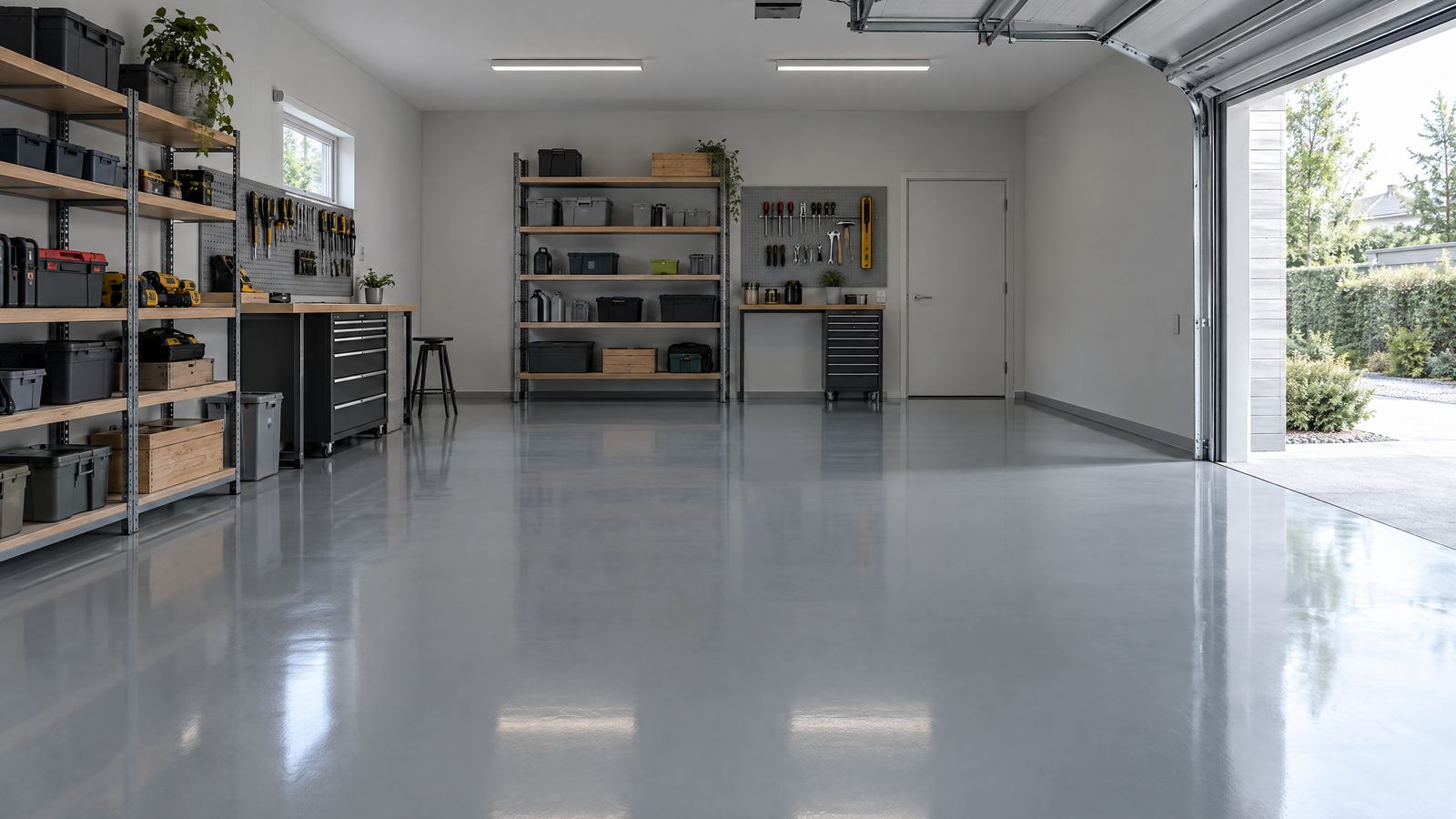
Epoxy floor cost per m² depends on the condition and moisture of the concrete, substrate preparation, resin thickness and grade, the use of the space and the topcoat. In standard spaces the layer is 1.5 to 3 mm thick, while industrial systems go over 5 mm. So a flat, a shop and a garage do not cost the same per m². We give the exact price after assessing the substrate.
Key facts
- An epoxy floor is poured as a liquid and levels itself into a flat surface without joints.
- The layer is 1.5 to 3 mm thick in standard spaces, and industrial systems go over 5 mm.
- You can walk on an epoxy floor 24 to 72 hours after the last coat.
- Epoxy goes on a hard, solid substrate, above all concrete. Wood is not a good substrate.
- In a space with constant traffic of people and equipment, a quality epoxy floor lasts up to ten years.
What is included in the cost of an epoxy floor?
The price of an installed epoxy floor covers assessing the load, preparing the concrete, the primer, the main resin layer and a topcoat in the sheen you choose. The price of resin from a shop covers only the material. So two epoxy floor quotes can only be compared once it is clear what each one includes, line by line.
| Item | What it covers | What it depends on |
|---|---|---|
| Traffic assessment | Choosing the resin grade for the load and chemical exposure | The use: flat, shop, kitchen, garage, warehouse |
| Substrate preparation | Mechanical grinding, opening the pores, filling cracks and levelling | The condition and flatness of the concrete |
| Primer | A penetrating primer for a strong bond with the substrate, plus a vapour barrier where needed | The moisture in the concrete |
| Main layer | Self-levelling resin, with air bubbles rolled out | The thickness: 1.5 to 3 mm or over 5 mm |
| Topcoat | A clear coat in the chosen sheen, with UV stability | The sheen, and whether an anti-slip surface is needed |
| Decorative effect | Flake or another decorative option | The effect you choose |
What types of epoxy floor are there and why do their prices differ?
Quite different things are sold as an epoxy floor: a thin epoxy coating for concrete, a self-levelling epoxy floor, an industrial system and a decorative epoxy floor. They differ in thickness, in the load they carry and in the amount of work involved. So comparing prices only makes sense between the same types of epoxy.
| Type | What it is | Where it is used |
|---|---|---|
| Epoxy coating | A thin protective coating over concrete | Protecting concrete from dust and oil in utility areas |
| Self-levelling epoxy floor | Resin that is poured and levels itself, 1.5 to 3 mm | Flats, shops, commercial kitchens, clinics, showrooms |
| Industrial system | A thicker layer, even over 5 mm, for heavier loads | Warehouses, production areas, garages and vehicle workshops |
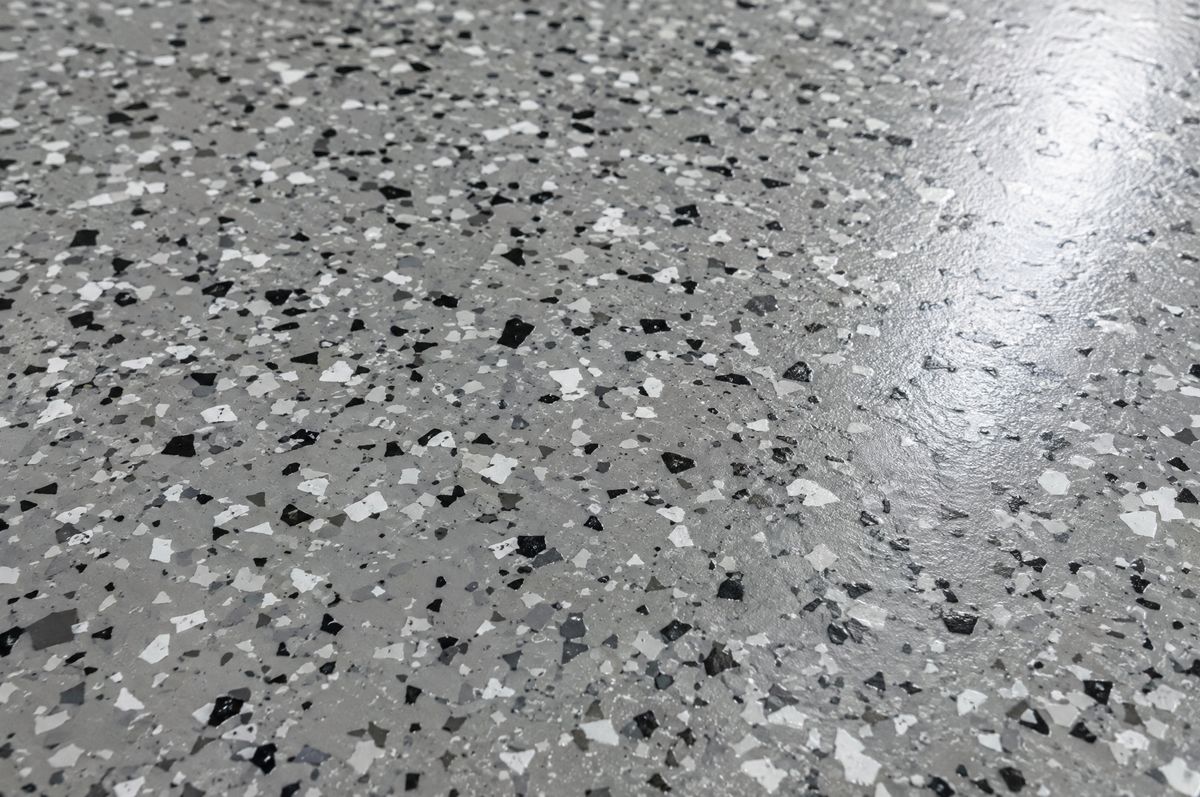
| Decorative epoxy floor | A self-levelling floor with a flake effect, a marbled effect or a clear layer over a graphic design | Showrooms, shops, flats and studios |
A coating and a floor are not the same thing. A coating protects the existing concrete, while a self-levelling floor is a new, flat surface without joints. We install self-levelling epoxy floors, with the thickness and resin grade matched to the load.
What affects epoxy floor cost per m²?
Epoxy floor cost per m² depends on the condition and moisture of the concrete, the thickness and grade of the resin, the use of the space, the floor area and the topcoat. The substrate moves the price most, because only on site can we see how much grinding, crack filling and levelling is needed before the first coat of resin.
Condition and moisture of the concrete
Epoxy goes on a hard, solid substrate, above all concrete, and with the right preparation also on stone or marble. The concrete is mechanically ground to open the pores, and cracks are filled. When the concrete calls for it, a vapour barrier also goes under the resin.
Wood is not a good substrate for epoxy. Wood shrinks and expands with temperature and moisture, so the epoxy layer cracks over time.
Thickness and resin grade
In standard spaces the layer is 1.5 to 3 mm thick, and industrial systems go over 5 mm. The resin grade is chosen for the traffic, chemicals and impacts the floor has to withstand. A thicker layer and a stronger grade mean more material and more work.
What the space is used for
A flat, a commercial kitchen and a garage need different systems. Kitchens and clinics need chemical resistance and easy disinfection, a garage needs resistance to oil and chemicals, and a flat needs above all a good look and easy upkeep. The differences are described in more detail below.
Floor area and the shape of the space
A small area costs more per m² than a large one, because preparation, getting the team on site and drying time are the same. Corners, columns, drains and transitions to other floors take more hand work than an open, rectangular surface.
Topcoat and sheen
The clear topcoat sets the sheen: matt, satin or semi-gloss. Where the floor is often wet, we choose an anti-slip topcoat. Decorative flake and anti-slip flake are listed in the quote as separate items.
How does an epoxy floor differ in a flat, a shop and a garage?
An epoxy floor in a flat, a shop and a garage is the same material, but not the same system. It differs in resin grade, thickness and topcoat, because each space takes a different load. That is why an epoxy floor quote is not based on floor area alone, but on what the space is used for.
| Space | What the floor has to withstand | What we pay attention to |
|---|---|---|
| Flat and loft | Everyday foot traffic, furniture, cleaning | Colour, sheen and look; underfloor heating with a suitable system |
| Shop and showroom | Constant foot traffic and equipment on wheels | Resistance to wear and scratches; a gloss or matt surface that reflects light |
| Commercial kitchen, clinic, laboratory | Chemicals, water and frequent disinfection | Chemical resistance and a surface without joints |
| Garage and vehicle workshop | Oil, chemicals and the weight of vehicles | Resin thickness and grade, depending on whether only cars come in or heavier equipment too |
Epoxy in a flat
In a flat, epoxy gives you one surface without joints, in a solid colour or with a decorative effect. It is chosen for open-plan flats, lofts and studios, where one continuous floor is wanted throughout. With the right system it also suits underfloor heating.
Epoxy in a garage
Garages and vehicle workshops are one of the typical uses for epoxy. The floor has no joints, withstands oil and chemicals and is easy to wash. In a shopping centre garage with constant traffic of people and vehicles, a quality epoxy floor lasts up to ten years, after which it is repaired or a new layer is applied.
Anti-slip topcoat
Where the floor is wet or dusty, as in a garage, workshop or kitchen, we choose an anti-slip topcoat. We also offer anti-slip flake, which combines a rougher surface with a decorative look.
Why isn't the price of a tin of epoxy the cost of a floor?
The price of a tin of epoxy, from any manufacturer, is for the material, not for an installed floor. It does not include grinding the concrete, filling cracks, primer, a vapour barrier, the pouring work or the topcoat. That is why the price of resin per kilo cannot be compared directly with a contractor's price per m².
When you search for prices, note too that epoxy resin for casting tables and decorative pieces is sold under the same name. It is a different product with a different purpose, and its price tells you nothing about the cost of a floor.
The biggest risk in doing it yourself is the preparation. Resin on poorly prepared or damp concrete can come away from the substrate, and a fault like that is not repaired locally. Instead, the layer has to be taken off.
Epoxy vs microcement, which is better for a flat?
Epoxy and microcement are two different floors, and the choice depends on the space, not just on the price. Epoxy carries heavier loads and is easier to disinfect, so it goes into warehouses, kitchens and laboratories. Microcement is installed over the existing floor and has a mineral look, so it goes into flats, boutiques and offices.
- Epoxy is a liquid resin that levels itself into a flat surface without joints, in a layer 1.5 to 3 mm thick.
- Microcement is made by hand in 5 to 7 layers, with a final layer 1 to 2 mm thick and visible trowel marks.
- Epoxy goes on concrete, and with preparation also on stone or marble. Microcement also goes over solid tiles, without demolition.
If you are not sure what you need, tell us what the space is used for and we will suggest a system. A comparison of all the floors we install is in our article which floor to choose, and what microcement cost depends on is explained in how much microcement costs.
How do you get an accurate quote for an epoxy floor?
We give an accurate epoxy floor quote after assessing the substrate and the use of the space. The resin grade, thickness and preparation depend on both, so a price given over the phone would not be responsible. You choose the colour and effect on 30×30 cm sample panels, which we pour before the project is confirmed.
- Send us the location, what the space is used for and the approximate floor area.
- We arrange an on-site assessment of the concrete and the load.
- You choose the colour, sheen and effect on 30×30 cm sample panels.
- You receive a written quote covering the preparation and every layer.
- After installation, the floor can be walked on 24 to 72 hours after the last coat.
Send your enquiry through the epoxy floor enquiry form, and see colours, effects and uses on the epoxy floors page. If you are planning a floor outdoors, read our article on terrace flooring first.
Frequently asked questions
How much does an epoxy floor cost per m²?
Epoxy floor cost per m² depends on the condition and moisture of the concrete, the thickness and grade of the resin, the use of the space, the floor area and the topcoat. That is why we give the exact price after assessing the substrate, in a written quote listing the preparation and every layer.
How much does an epoxy garage floor cost?
The cost of an epoxy garage floor depends on the condition of the concrete and on whether only cars come in or heavier equipment too. We choose the resin thickness and grade accordingly, with an anti-slip topcoat where needed. A home garage and a shopping centre garage do not need the same system.
Can epoxy go over tiles?
Epoxy goes on a hard, solid substrate, above all concrete, and with preparation also on stone or marble. Whether existing tiles can stay underneath is something we assess on site. If you want a new floor over tiles without demolition, have a look at microcement too.
Is epoxy more expensive than tiles?
Epoxy and tiles should be compared on the cost of the whole job, not the price of the material. With tiles the price includes adhesive, cutting and grouting, and with epoxy it includes preparing the concrete, primer and the resin layers. Which works out better depends on the substrate and the use of the particular space.
When can you walk on an epoxy floor?
You can walk on an epoxy floor 24 to 72 hours after the last coat. The exact time depends on the system and the conditions in the space. When the floor can take its full load, for example when vehicles can drive into a garage, is agreed separately.
How long does an epoxy floor last?
Up to ten years in a space with constant traffic of people and equipment, such as a shopping centre garage. How long it lasts depends on the resin grade, the use of the space and maintenance. After that the floor is repaired or a new layer is applied.